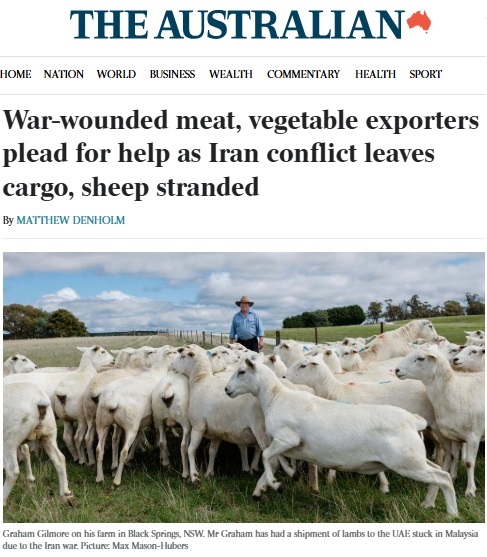
An article in The Australian has highlighted the deepening crisis facing Australian exporters as Middle East conflict throws key supply chains into disarray, with cargo stranded, rerouted, delayed or abandoned mid-transit and exporters hit with crippling war risk, fuel and deviation surcharges. The report also points to the growing use of "end of voyage" declarations, leaving cargo owners to absorb the cost of recovery, storage, rehandling and onward movement, while the broader fallout threatens business continuity, export competitiveness and ultimately consumer prices in Australia.
FTA Director Paul Zalai said:
"Surcharges create an immediate cashflow shock, often resulting in budget overspend. Smaller exporters, particularly in agriculture and regional Australia, face escalating cashflow crises that threaten business continuity.
These impacts are compounded by 'end-of-voyage' declarations, where shipping lines terminate contractual responsibilities mid-route, often accompanied by deviation surcharges … Cargo owners then bear the full cost of recovery, storage, rehandling and onward movement.
Chilled and time-sensitive cargo is especially at risk, with shelf-life expiry leading to 100 per cent product loss in some cases. These costs risk undermining export competitiveness, regional employment, farmgate returns and broader supply-chain stability."
FTA General Manager – Freight Policy & Operations Tom Jensen said:
"It's going to affect consumer prices."
APSA member and Australian Meat Industry Council chief executive Tim Ryan said:
"It's a major market for Australian red meat, particularly sheep meat, and a lot of it has always been chilled product – and getting that into the region is particularly challenging at the moment."
"Everyone is still unpicking the logistics of containers stranded in ports where they weren't supposed to be. Some of it has been brought back to Australia, some has been redirected to other markets, or has found another way into the intended destination.
"Now a lot of exporters are looking at alternative ways to get into the region. We're hearing of shipments going around Africa, down through the Suez (Canal), the top end of the Red Sea."
Read the full article in The Australian.