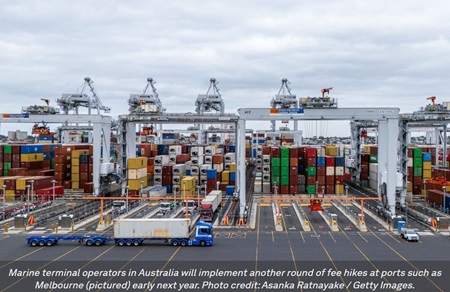
Australian shipper groups have welcomed comments from the Australian Competition and Consumer Commission (ACCC) suggesting that government policy or regulatory intervention may be required to address escalating terminal access charges and related landside fees.
As reported by the Journal of Commerce, the ACCC's latest Container Stevedoring Monitoring Report found that terminal operators are "charging record high prices and making historic profits", despite significant spare capacity at ports and relatively stable costs and productivity.
The ACCC stated that "a government policy or regulatory response is likely required to address apparent market failures and improve Australia's container freight supply chain to the benefit of households and businesses", noting that stevedores are now charging higher real prices per container than at any time in the 27 years the commission has monitored the sector.
FTA/APSA General Manager – Freight Policy & Operations Tom Jensen said the report confirms long-held industry concerns.
"The ACCC has now confirmed what industry has been warning about for years — stevedores are ramping up prices in an environment where costs are stable, productivity has gone nowhere, and terminals are sitting on spare capacity," Mr Jensen said.
Mr Jensen said the regulator's assessment leaves little ambiguity.
"The ACCC has effectively said the quiet part out loud — this market isn't working. The regulator has identified the problem, quantified it, and flagged the solution. What's needed now is for government to act."
The report also highlighted that terminal access charges generated $426 million in 2024–25 and more than $2 billion since 2017–18 — around two-and-a-half times the level of terminal investment over the same period.
"When terminal access charges alone are worth two-and-a-half times the total investment made by terminals, it's clear these fees have become a profit lever, not a cost recovery tool," Mr Jensen said.
The ACCC has indicated it will discuss the report's findings and potential follow-up action with federal government officials early next year.
READ ARTICLE HERE